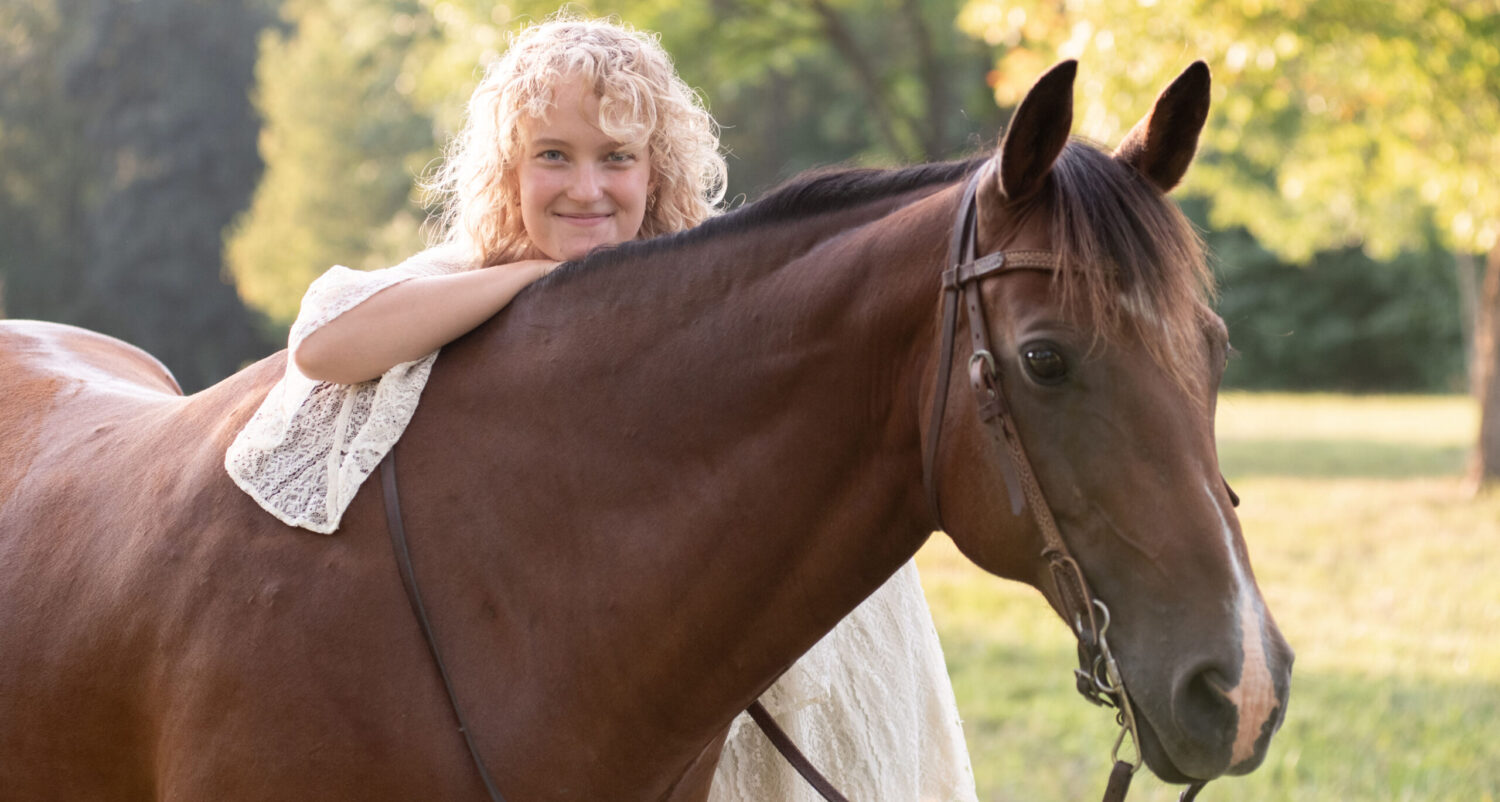
Recently, I have had the wonderful opportunity to do an interview with one of my favorite authors, Gillian Bronte Adams! She is the author of The Fireborn Epic and The Songkeeper Chronicles, both of which are fantastic series. In fact, she just released the absolutely epic conclusion to The Fireborn Epic, Of Dawn and Embers! The Fireborn Epic is probably my favorite series ever, and a review of Of Dawn and Embers will be releasing soon. For now, on with the interview!
1. The Fireborn Epic has very realistic horses, even though they’re fantasy horses. How did you strike the balance between fantasy and realistic elements when it comes to the horses?
I’ve spent most of my life around horses, and for a number of years, I worked with my horse at a youth camp, running their horsemanship program. The working relationship that you build with a horse is unlike any other human/animal bond I’ve ever experienced—you grow to anticipate each other so well that at times it seems like you’re thinking, moving, and acting as one. So one of my main goals was to try to capture the beauty of that real world bond by creating fantasy horses that live and breathe and feel like real world horses—just with the added benefit of some magical abilities.
In a way, I think it makes The Fireborn Epic feel that much more authentic, because it is grounded in something you can actually experience. You can go out and ride a horse with fiery temperament, like Mindar, or one that is mischievous and loyal like Ghost. You may not be able to summon a wave or vanish into the shadows with your steed, but you can forge a bond through trust, just like in this series. Having spent many years helping young riders experience that moment, I would love for this series to inspire readers to appreciate the wonder and beauty of real world horses too.
2. I’ve noticed some Biblical themes in your books, especially the Songkeeper Chronicles. How have you gone about weaving Biblical themes into your books?
Each story I write ends up looking a little bit different. Some stories come with strong Biblical themes attached. Others carry deeper, more subtle themes that are intricately woven into the fabric of the storyworld or the character arcs themselves. I probably tend more toward the latter these days, but I’ve learned to let each story go where it needs to, and sometimes the themes that end up surfacing through the characters’ journeys surprise even me.
I view my art as something that I get to walk through with the Lord, just like the rest of life. That looks like praying over difficult character arcs and over days when the words won’t come and for stories that, whether or not they carry overtly Biblical themes, still point to what I believe to be true about the world: that it has been broken by evil, but restoration has come (through Jesus) and is coming. That hope means that we don’t have to shrink back from the darkness as writers, but it also means that we don’t have to shy away from the reality of the light that bursts through.
3. What was the process of finding an agent and publisher like?
It was absolutely surreal in many ways and quite the roller coaster ride in others. I’d done a lot of creative writing growing up, and when I graduated high school, I ended up pitching a novella to a very small press that had published several books I’d read. They ended up offering me a contract, and suddenly, I found myself on the fast track to learning absolutely everything I could about writing and publishing.
That contract ended up falling through before my novella released, but at that point, I had a novel-length manuscript that was 75% completed, and I knew I wanted to go to a writers’ conference. I met my first agent at that conference, thanks to an introduction from a friend. She invited me to send her my full manuscript, and I ended up signing the first full-length novel I’d ever completed. I pitched that same novel to publishers at the same conference a year later, and eventually signed it with Enclave Publishing. It became Orphan’s Song, book one of The Songkeeper Chronicles. Fast forward three books and six years, and I signed Of Fire and Ash with Enclave as well.
It’s wild for me to look back and realize just how much more I know now than I did then. So, I’m truly grateful for the opportunities I’ve had, and I’m thankful for every day that I have the chance to continue telling stories.
4. What inspired you to write deep, epic books?
I honestly don’t think I know how to write anything else! I’ve tried—and for some reason, I keep trying—to tackle something short and light and cozy, and somehow, it always ends up stretching deep and wide and carrying those epic undertones. At the end of the day, I think we tend to write the stories that resonate with our hearts on some level, and I suppose my heart has always been attuned to stories that hum with heroic deeds, that highlight the small and beautiful things, and that feature characters who hold on to what they’re fighting for, despite overwhelming odds.
Those were the stories I found myself picking up even as a child. I was the seven-year-old hauling around my giant copy of The Lord of the Rings, devouring retellings of the Song of Roland and Horatius at the Bridge, and eagerly latching onto every fierce and epic story I could find. Even better if featured both male and female warrior characters. Those stories sparked something inspiring inside of me and made me want to be fiercer and braver than I could ever have imagined otherwise. So, when I took up the pen, those were the stories I longed to write too.
5. Many of my readers (and myself) are young writers. What advice do you have for aspiring authors?
Writing is one of those art forms where there is always something more to learn, and I find that knowledge both freeing and inspiring. It’s freeing because it means that striving for absolute perfection is impossible, so there’s no need to make that the goal. Instead, you can strive to tell a story that will move and impact readers to the best of your abilities now, and that is more than enough. And it’s inspiring because it means that when you run up against a book where the character work makes your heart soar or the intricacies of the plot feel out of this world, there’s not need to let imposter syndrome creep in. Even if you cannot yet imagine how the author did it, it doesn’t minimize who you are as a writer. It just means there’s another opportunity to grow. With writing, there are always new ways to challenge yourself and hone your skills, and as an art form, it never gets boring.
Having that kind of a growth mindset is also valuable because the more skills and abilities and random bits of knowledge you gain, the more you have to draw from when you need to constantly shift hats as a published author, from writer to marketer to speaker and more.
6. Will there be any more stories in the world of the Fireborn Epic?
I think it’s safe to say that I’m not done writing in the world of The Fireborn Epic yet. There’s a lot still to explore, both with beloved characters in familiar settings and places we haven’t seen before, so while I don’t have anything to announce or any immediate plans to share with you guys, I’m not yet ready to say farewell!
7. Finally, are there any writing projects that you’re particularly excited about working on?
I am currently balancing three writing projects, which is far from ordinary for me. I usually latch onto one idea and lock in so much that I’m basically living, sleeping, eating, and breathing that story until I finish. But the struggle I’m facing right now is that every time I pick one of the three to work on, I somehow manage to open up one of the others instead, and I am so excited about all three of them that I can’t seem to stop.
I think the fact that they are all so different is a part of it: one is a grand epic fantasy world for adult readers which is involving a lot of worldbuilding at the moment (one of my favorite pieces), one is young adult epic fantasy, and the other one is a literary style middle grade fantasy (and I’ve been particularly enjoying experimenting to find the right voice for it). So, progress has been slow, because it has been split across three projects, but I do have the freedom to set my own pace at the moment, and it’s been fun to reconnect with the kind of creativity where you can just let inspiration sweep you away!